

TRANSIT SERVING THE EAST BANK
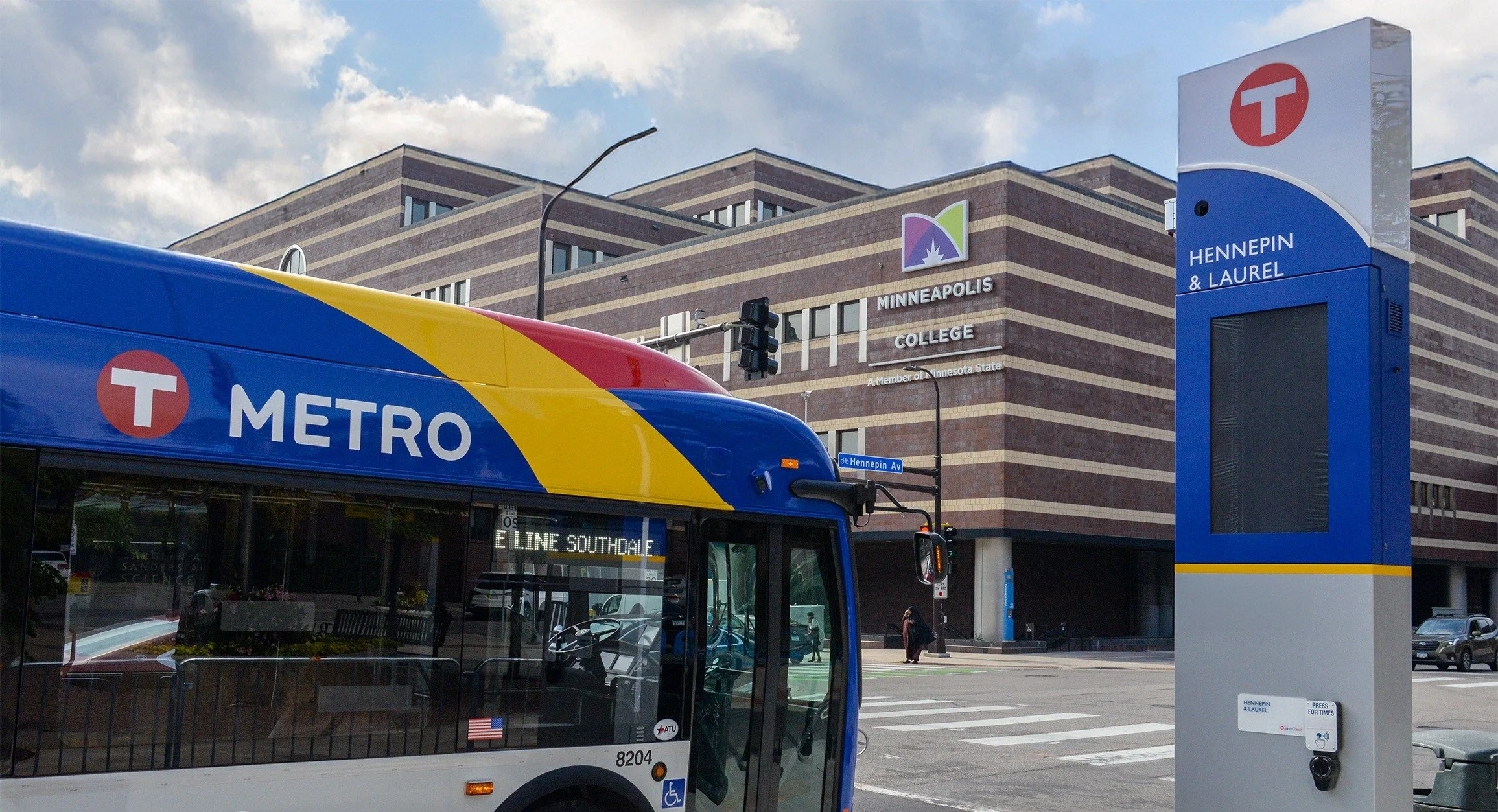

Bus Service in the East Bank Neighborhoods
The East Bank Neighborhoods are among the most transit-connected areas in the Twin Cities, with strong bus service linking residents to downtown Minneapolis, the University of Minnesota, Northeast Minneapolis, and Saint Paul.
At the center of this network is the METRO E Line, a high-frequency Bus Rapid Transit (BRT) route operated by Metro Transit. With fast service, all-door boarding, and frequent stops along key corridors, the E Line has become a primary way to move through and beyond the East Bank.
METRO E Line: The East Bank’s Transit Backbone
Launched in December 2025, the METRO E Line provides fast, reliable, and frequent service through the heart of the East Bank neighborhoods.
Key benefits:
Frequent service: Approximately every 10 minutes on weekdays
Major corridor: Runs along Hennepin Avenue and University Avenue SE
Regional access: Connects downtown Minneapolis, Uptown, and Edina (Southdale area)
Faster boarding: Off-board fare payment and all-door entry
For many East Bank residents, the E Line is now the go-to route for daily travel, offering a faster and more reliable alternative to traditional bus service.
Key Supporting Routes
While the E Line serves as the backbone, several routes complement and extend transit access across the East Bank:
Route 2: A key east–west route connecting Uptown, Seward, and Marcy-Holmes
Route 3: Connects downtown Minneapolis, the University of Minnesota, and downtown Saint Paul
Route 4: Travels along Central Avenue, linking to Northeast Minneapolis and beyond
Route 10: Serves Central Avenue NE and downtown
Route 30: Crosstown service linking Como, Northeast, and Prospect Park
Route 61: Connects East Hennepin Avenue to Saint Paul and Roseville
Nicollet Island / East Bank
METRO E Line: Primary service along Hennepin Avenue
Route 4 + Route 10: Frequent service along Central Avenue NE
Route 61: Cross-town connection via East Hennepin Avenue
This neighborhood benefits directly from the E Line’s fast connection into downtown and beyond.
Marcy-Holmes / Dinkytown
METRO E Line: Runs along University Avenue SE and Hennepin Avenue
Route 2: Strong east–west connection along 8th Street SE
Route 4: Connects via Central Avenue SE
Route 61: Links to Saint Paul and surrounding areas
With multiple E Line stops nearby, Marcy-Holmes residents have some of the fastest transit access in the city.
University Neighborhood
METRO E Line: High-frequency service along University Avenue and 4th Street SE
Route 2: Links to Uptown, Seward, and Riverside
Route 3: Core campus route connecting both downtowns
Campus Connector (Route 121): Free University of Minnesota shuttle
The E Line plays a critical role in moving students, staff, and visitors efficiently through campus and beyond.
Southeast Como
Route 3: Primary service along Como Avenue
Route 30: Crosstown connection via 15th Avenue SE
Route 61: Access via East Hennepin Avenue
While the E Line does not run directly through Como, it is easily accessible nearby and expands regional connectivity.
Mid-City Industrial
Route 17: Service along Washington Avenue North
Route 30: Crosstown route along Industrial Boulevard and Hennepin Avenue
The E Line provides nearby access that strengthens connections for workers commuting into the industrial district.
Getting Around
With the addition of the METRO E Line, transit across the East Bank neighborhoods is faster, more frequent, and more reliable than ever.
To plan your trip, view schedules, or track buses in real time, visit Metro Transit or use their mobile app.
CAR SHARING SERVICES
Car-sharing services are a convenient and sustainable transportation option in the East Bank Neighborhoods. We benefit from our proximity to the University of Minnesota, downtown Minneapolis, and high-density residential areas, creating ideal locations for car-sharing services. Below is an overview of the car-sharing options available:
Zipcar is one of the most prominent car-sharing services in the area, particularly in the University neighborhoods. With vehicles located on and near the University of Minnesota campus, including Marcy-Holmes and Como, Zipcar offers flexible rental options by the hour or day. Popular parking spots include lots near Dinkytown, the East Bank, and Stadium Village, making it convenient for students and residents to access a vehicle for errands or trips. Members can book vehicles via the Zipcar app, and gas and insurance are included in the cost.
HOURCAR, a local nonprofit car-sharing service, operates in the Twin Cities and serves the Marcy-Holmes, Nicollet Island-East Bank, and University neighborhoods. Vehicles are parked at designated hubs, including near the University of Minnesota, in Dinkytown, and along Central Avenue. HOURCAR focuses on sustainability, with a fleet that includes fuel-efficient and hybrid vehicles. Membership includes hourly and daily rental rates, and it’s an excellent option for residents seeking a local alternative to traditional car rental services.
Evie Carshare is the Twin Cities’ all-electric car-sharing service, operated by the same organization as HOURCAR. Evie’s fleet of electric vehicles is available for one-way trips, with charging stations scattered across Minneapolis and St. Paul. This service is particularly convenient for residents of Marcy-Holmes, Nicollet Island-East Bank, and the University neighborhoods, offering eco-friendly transportation with affordable pay-as-you-go pricing. Evie also integrates with the HOURCAR network, providing members with access to both services.
For those looking for a peer-to-peer car-sharing option, Turo allows residents in these neighborhoods to rent vehicles directly from local owners. Turo offers a wide range of vehicle types, from budget-friendly options to luxury cars. This service is ideal for longer trips or specific needs, as renters can choose the type of vehicle that best suits their plans. Availability depends on individual owners, but the high population density in these neighborhoods ensures a variety of options.
Although not traditional car-sharing, Lyft and Uber now offer short-term car rental options through their respective apps. These services are designed for flexible use, with vehicles available for a few hours or days. While these options may not have dedicated hubs in the neighborhoods, they are accessible through app-based reservations and can be a convenient alternative to car ownership.